1st. Following several days in St Georges dealing with odds and ends, treating friends to lunch and organising for Paul and I to rent the downstairs apartment for his visit, I have finally hit the road, heading for Brittany.
First stop L’Aiguillon-sur-Mer on the mouth of the River Lay at the point where it joins the Atlantic. It is a real holiday resort with wonderful amenities which include a very large boul park, a fantastic children’s play ground, a fake sandy swimming beach complete with life guards, a water play park….


but perhaps the biggest attraction is the teleski park complete with ramps for the wake boarders. (Chris would like this one)


There is at the same time a port all along the banks of the river which includes working boats as well as pleasure boats.


2nd Not such a long drive today in terms of distance but it took an age on small roads through the ribbon development of seaside towns and villages in heavy holiday traffic. Paused on route at the wetlands at Tranche-sur-Mer

and again at St Jard village to photograph the church which demonstrates the change in architecture. While most houses are a blinding white with red tiles roofs, the odd slate and thatched roofs are creeping in.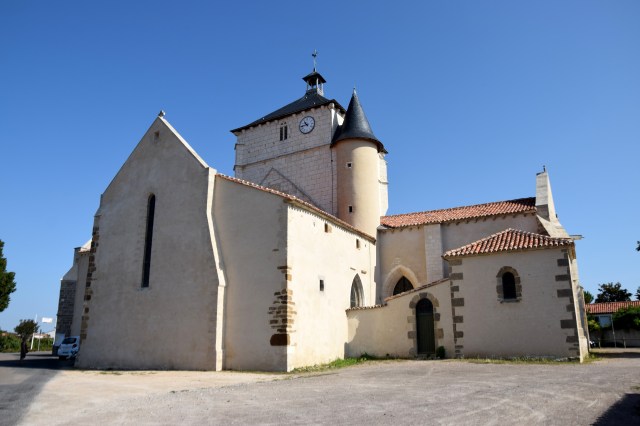
and sandstone has been replaced by granite giving the stone houses an altogether more somber look, reminiscent of South Wales and the similarity doesn’t stop there. Directional signs are now in two languages, French and Breton which is a form of Galich. Vannes is also signed as Gwened.


then pulling off the main road and heading for the ocean where the smell of O-zone was wonderfully overwhelming and the beaches were a mix of sand and rock pools with a view back to the Phare de l’Armandéche lighthouse.
Finally stopped on the Island, access via a high bridge, of Noirmoutier at an air next to a long sandy beach just over the dunes.
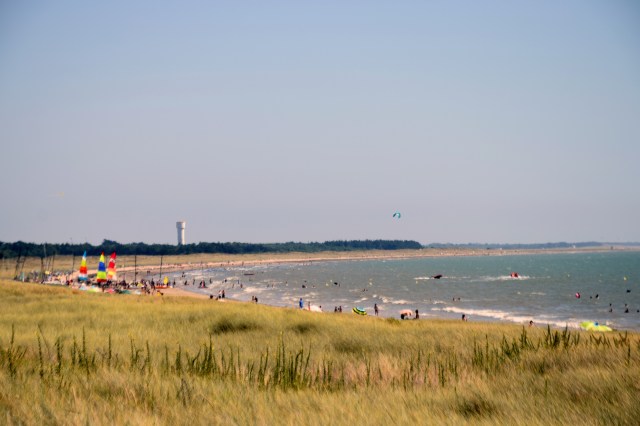
The area that I have been passing through for the last couple of days is know as La Vendée. It is substantially Marais (same in French as understood in Southern Africa) or marsh, in this case Salt marsh. It has been drained and is riboned with canals. Where it is not pancake flat it is because of ancient stabilised dunes, mostly near the coast and there is some coastal forest. The agriculture is predominantly cattle, both beef (Charelaise) and dairy (Freesland and Jersey) One shudderes to think what a relatively modest rise in sea water levels would do to this area!
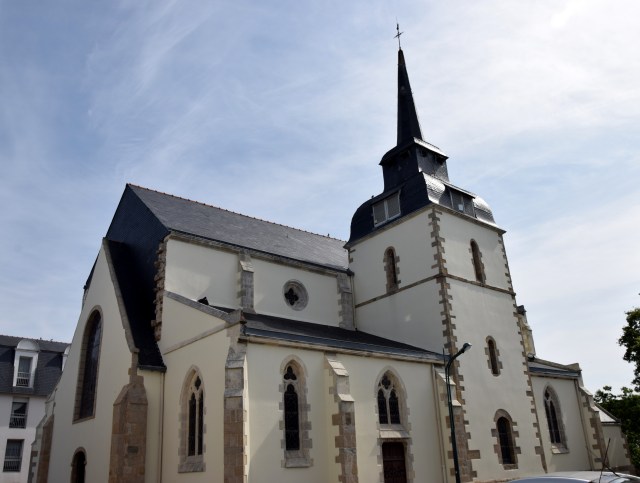
3rd. Cassidy had a lovely early morning walk over the dunes and along the beach. With no one else around he was able to run off lead and I paddled in the suprisingly warm Atlantic – swim next time! Then we headed for Montoir-de-Bretange which is basically a suburb of St-Nazaire, the first City in Brittany having crossed the huge and intimidatingly high bridge over the mouth of the Loire. Glancing down at the big container port I saw that one of the Airbus ships that are seen to pass St Georges on the Gironde was in port. I chose this Aire because it was a relatively short drive and it had unmetered electricity. The bonus of arriving on a Saturday is that the Town Hall offices were shut rendering payment impossible! Cassidy and I took a walk through the suburb and had a coffee but it really has nothing to recommend it which is a good thing as I did not need any distractions from getting a load of work and admin up-to-date while I could plug in the computer and printer. It does have an attractive church though.
4th. There is a strip of wetland with paths between the suburb of Montoir and the Highway beyond which you can clearly see the container port. Cassidy and I took our walk there this morning before leaving and disturbed a family of Otters in one of the trenches. The kits dashed under the culvert and what was probably the mother scooted off in the opposite direction, no doubt as a diversionary tactic. Added to the Sparrow Hawk that swooped into the Aire right in front of me yesterday afternoon it was an amazing amount of wildlife for the city!
We followed the highway initially to get past the ribbon development around St Nazaire and head for the wilder Brittany coast. This route took us to the Medieval walled city of Guérande parts of which date back to C12/13 however the impressive St Michel entrance gate is C15.
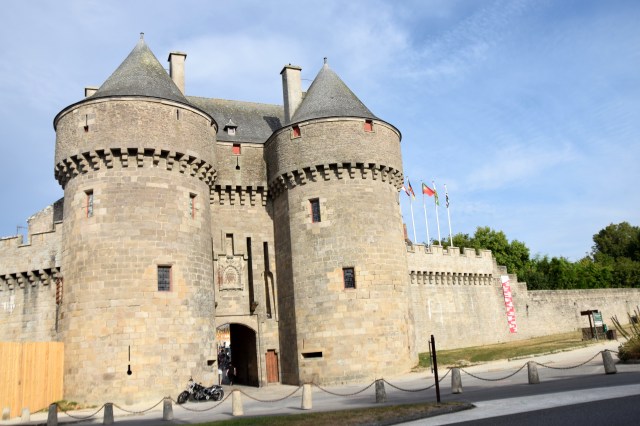


I wanted to take a walk along the ramparts but when I went to buy a ticket to access them I was told dogs were not allowed. The man in the ticket office kindly let me secure Cassidy and run up to take a couple of photos.


The church and a number of other buildings in town were built of granite and every building had a slate roof. It was difficult to get far enough away from the church to gat a photo that does it justice. Round one side of the church there were iron cast figures on poles.


The main street was packed with the usual tourist trap shops but there were also delightful wall niches and lovely shop signs.


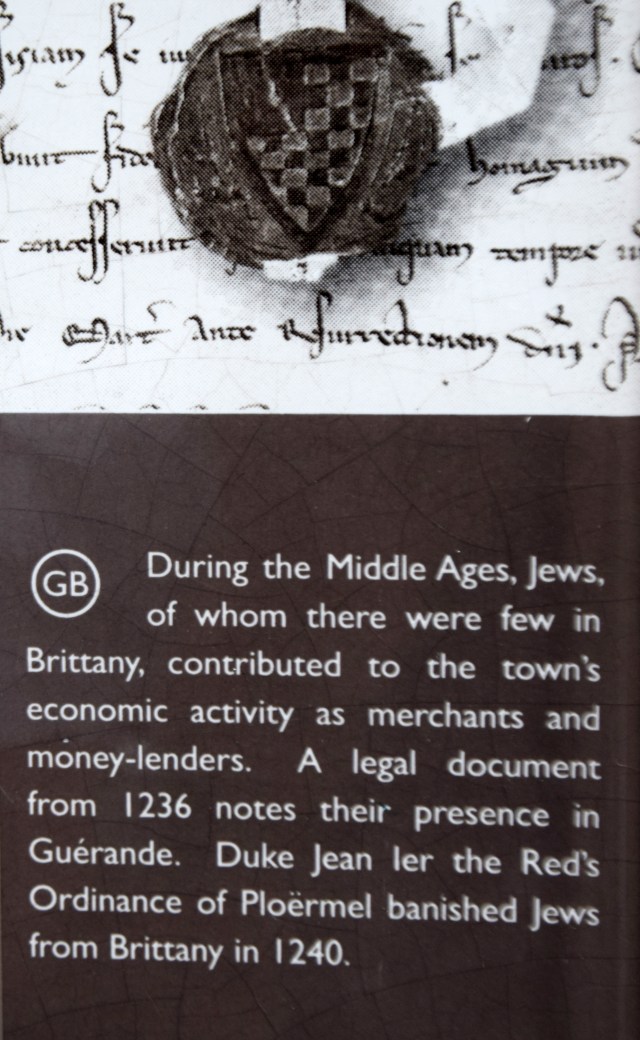
WHICH JUST GOES TO SHOW THAT ANTISEMITISM IS NOTHING NEW.
We continued on to the coast and the little port village of Lerat whose Aire was recommended in the book. The Aire was crowded and not very attractive but the port ad little beach was nice.


A local notice board showed another aire further along the coast so we drove on and found a really delightful sea facing Aire at Brambells. Lovely Cliff-top walks, mussel banks off shore and a nice little beach. I missed harvesting sea food because I missed the tide but there will be other opportunities.


The sunset view from the Aire was dramatic.


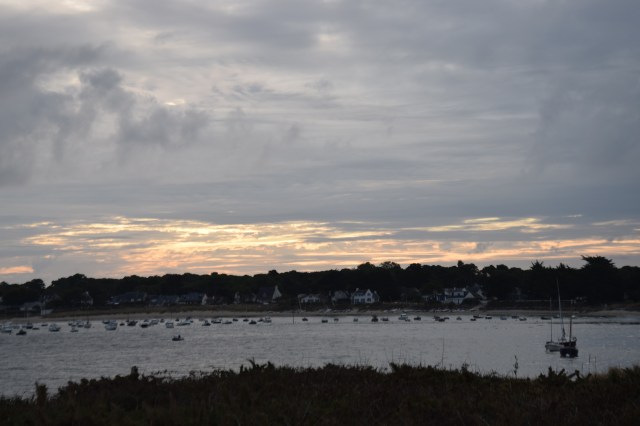
5th. A Cliff-top walk under lowering skys, promising rain, with views of Quimiac before heading on.
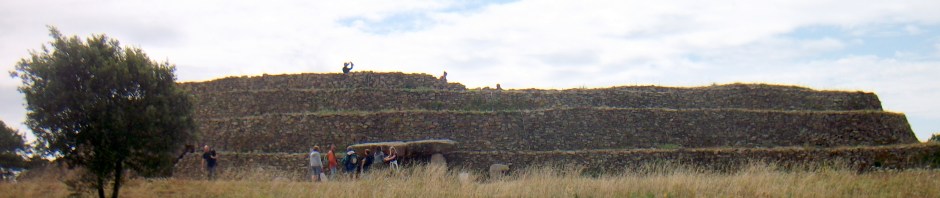
Our target today is the beginning of the Megalith trail that peaks at Carnac. This is an area that I have long wanted to visit given my interest in Neolithic history ( or as Pippa would have it “Old ruins”). The Aire outside Arzon is meters from the beach and a walk through a coastal park to the town, port and waterfront development. I left Cassidy in the van as it was raining and he really doesn’t like getting wet! I headed off to the first Neolithic site of “Cairn de Petit Mont”. It is a huge burial mound about 55m in diameter with three known chambers. Considerable damage was done in WW2 by the German army’s building of a bunker within the Cairn. The bunker remains in place but access to all three chambers has been facilitated by restoration work undertaken between 1979 – 1989.


With the phenomenal views over the surrounding seas the value of this site for the bunker is obvious but for me the destruction of the historical monument is inexcusable. I am sure that the German army is not alone in executing this type of willful damage.
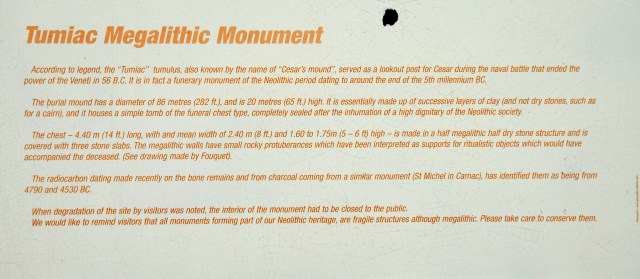
6th. It rained solidly all morning but not till Cassidy and I got back from our morning walk. After lunch the sun came out and we set off to find the tumulus called Le Butte de César. This turned out to be a disappointment as the burial chamber had been closed off as the notice below explains.
So as consolation we wandered down to the waterfront and had a coffee and cake, YUM! Brittany is Yachties heaven so it is no wander that there are small craft harbours all along the coast and Arzon is no exception.


Then it was down to the beach, all of 100m away, and a good swim.
7th. An horrendous drive in nose to tail traffic to get to Quiberon. In addition the tooth that the dentist in St Georges, before I left, said was not a problem, is a problem. There is the beginning of an abscess behind it giving me a mild head ache and ear ache. I managed to get to see a Doctor who prescribed antibiotics and have a dental appointment for Friday. The campingcar Aire is not good and very expensive. Euro 13.50 per night and that doesn’t include water. I have managed to plug in however. Lots of campers have looked it over and moved on. One is parked under the trees across the road! One bonus is that there was a Dolmen just across the road from where I parked to access the Doctor.


8th Another mucky day, overcast and rain.Got into cycling gear and went out on the bike anyway. Followed the coast road back down to Quiberon. There is a lot of WW2 defense stuff on the peninsular and a rather curios construction at Port Kebau. There was no story board or other explanation for the U shaped deep harbour with an exit to the sea at one end of the U. My guess is safe parking for a small U/Boat!


This stretch of coastline is known as le Côte Sauvage. It is well served by walking and cycling trails, and it certainly is “wild”.


Since I was wet anyway I just continued following the cycle paths which took me past the Garden of the Lavoir du Ragot. A real little oasis of a community garden made and maintained by volunteers from the commune.
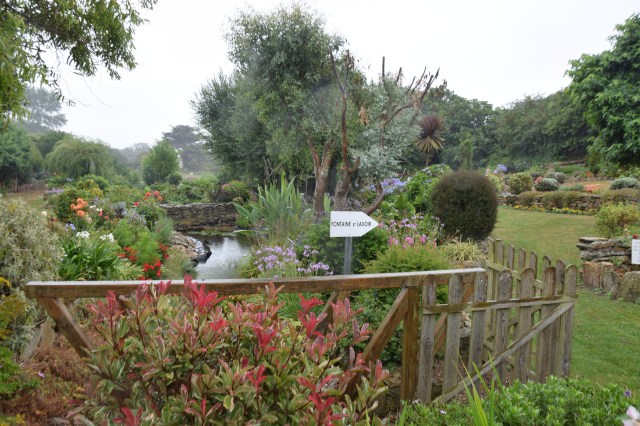
In the evening I was invited to Aperos with the English couple that had been in the last Aire. Emma, David and I spent a pleasant couple of hours exchanging stories of our days adventures.
9th A bit of a non day due to on/off rain and my dental appointment in the afternoon. I am pleased to say that all went well and in between cloud bursts Cassidy and I had pleasant walks round Saint-Pierre Quiberon. My turn to host Emma and David this evening. We will be going our separate ways tomorrow but it has been nice meeting them.
10th. The first dolmen on the way into Carnac and a taste of things to come.


Nearby was a Benedictine Abbey where the monks make natural and health products, they still say mass and vespers every day.


To get myself orientated I decided to take the open-top bus tour of the site followed by the English language guided tour.The stones are in a fenced off “corridor” about 400-500m wide and four kilometers long.The stones are arranged in long parallel rows, 11 – 13 wide, on an East – West orientation. They start with big stones, 2 -3m tall and decrease in size to end up with stones about 1m high. They are not aligned North/South so it is not a grid. I was disappointed with the site and the tour guide. The tour entered the corridor but moved about within a very limited area.The general message was that “We can only hypothesize as to why these lines were constructed or what purpose they served”. It felt as though she was speaking to a script and was not erudite in answering more in depth questions surrounding the archaeology of the area. I came away with the impression that this was very much a tourist trap with very little attention to educate. Fortunately there are other less accessible which benefit from having been neglected and only attracting the seriously interested.


Moving the van to the Aire we took a walk into town where we were delighted by wells, fountains and lavoirs.


The church also had interesting decoration over the porch.


We climbed the much publicized Tumulus St-Michel to the (closed) Christian chapel on top. Walking round the perimeter of the substantial long barrow two locked and bolted entrances to the interior of the tomb can be observed. Earlier today the guide had said that no carbon based materials had survived due to the acidity of the soil she had also stated that in the St-Michel Tumulus only one male body was found but with a quantity of jewelry and other artifacts. This has resulted in their hypothesis that he was an important personage and that it was a hierarchical society. A number of the artifacts found were not local, coming from as far away as Spain and Switzerland, indicating wide ranging trade.


All this contributes to the confusion as to why no domestic dwellings have been discovered, the skills were there to build stone dwellings and comparing this area with the contemporaneous sites on the Island of Orkney, is a conundrum.
11th. After giving Cassidy a good walk I set off on the bike to visit a number of Dolmen, Tumulus, Fountains and chapels. I totally failed on the fountains and chapels, only completed half of the 18k circuit but still managed to do over 28k, and out of the 8 monuments in the completed sector I completely failed to find 5 of them!


The second site was really interesting with lots of engravings in the intact tomb.


The third site was a “Long Barrow” with access to a chamber with engravings but also evidence through a metal hatch on top of the barrow of another chamber which was not accessible.


On the road I met a woman from Belgium, a social anthropologist, who has lived in the area for over 30 years. We had an interesting discussion about the whole “Carnac” experience and how it is being managed. She expressed her frustration with the poor provision of bike routes and the neglect of a number of the monuments. Her attempts to rattle the municipal cage from time to time have not born fruit and she suspects that the “Maison des Megaliths” at the Alignments is such a “gold mine” that they are complacent about making any more effort. For me that whole “Maison des Megaliths” area with its trip bus, trip train and viewing terrace, is all a bit “theme park”ish!
In the evening Cassidy and I walked into town for dinner. I had calamari & chips, a chocolate fondue and a glass of wine for Euro 21.50 which was in my mind a bit rich.
12th Up early to drive to Locmariaquer, no great distance, but the free Aire next to the sea is much in demand so I want to get in early. First stop, the site “Megaliths de Locmariaquer” billed as a “Spectacular archaeological adventure” which should have immediately alerted me to the possibility of disappointment. Two of the tombs are complete reconstructions (see post card), the giant broken Menhir is what it is and is only impressive because of its huge size and because it is of igneous rock as opposed to the local granite they can attest to it having been hauled from at least 10k away. Again there are other sites in the area that are less visited.


The most prominent and possibly of the most interest was just a stones throw from the Aire on the short cliff overlooking the sea. Unobtrusively fenced off one is instructed not to enter the area in order to preserve it. Which begs the question “Preserve it for whom?” This is the so called Dolmen of the Flat Stones.


Cycling round the bay I came across a good lunch spot offering 5 prawns, 4 sea snails, three oysters, a crab claw, bread, butter, lemon and a glass of Chardonnay all for Euro 15, now that is more like it. As I was ordering it started raining again so everyone came inside and I ended up sharing a table with a Parisian couple and talking the merits of Charente Marentime as a retirement area.
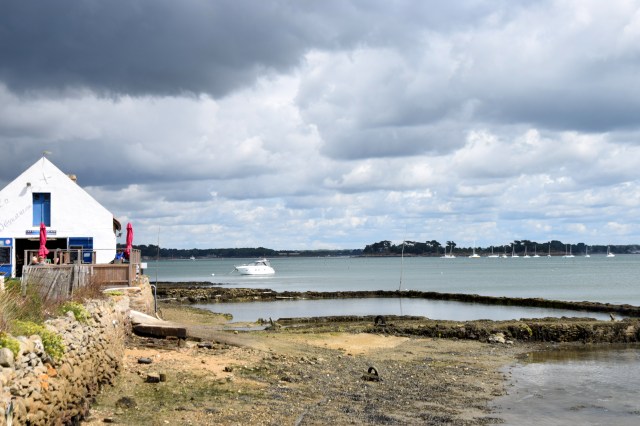
Next the Tumulus de Mané Er Hroeg. A fascinating site. The roof of the covering cairn has either caved in our been eroded leaving the impression of a crater. The entrance passage, which would formally have also been enclosed was open and the inner chamber was accessible. Inside I found two German men squatting round a lamp in earnest discussion. One was an Archaeologist and the other an Astro-physicist. They told me how axes had been found lined up with a North/South axis and pointing to corners of the chamber at those compass points. We had an interesting discussion including possible comparisons with Orkney which they had not yet visited. On the topic of domestic dwellings there answer was that none had yet been found and probably none existed to be found as they would have been built with wood (really?) and the acidity of the soil would have consumed all carbon based material? and any that do exist may be found under the Bay of Mobihan which was once dry land. (more hupothises!) But there are contradictions, if this is the case, how are they able to confidently assert that there was only one male body in the St-Michel’s Tumulus? The Astro-Physicist said that his friend had some ideas and that was why they were working together, probably relating to how the builders were able to align stuff in below ground building based on what they could see in the sky? I think where all these pronounced certainties are concerned I would prefer to follow the philosopher Karl Popper who said that just because we have no proof of the existence of something, doesn’t mean that it does not exist and that proof will not become available at some future date. After all the Neolithic village of Skara brae, one of the most important sites on Orkney, was only uncovered in 1850 after a storm substantially altered the dunescape.


Back in town there was a book sale at the port.
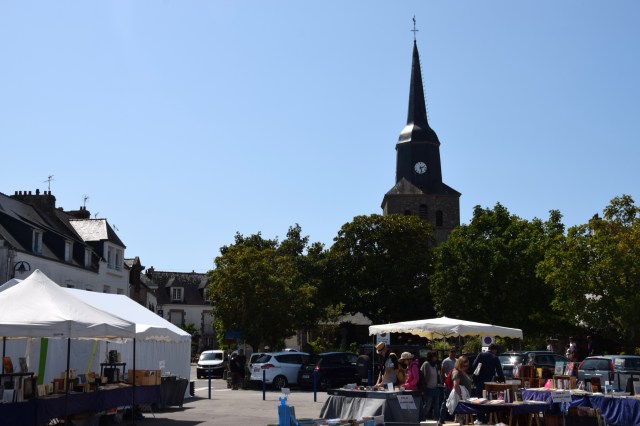
As relief from all the “Old ruins” I thought I would share some local seascapes.


13th Early start with the intention of stopping at Crach, which, according to my somewhat out-of-date Aire book, has a Supermarket and a launderette. Well either I missed it or it is no longer there so we continued to Erdeven and a very nice Aire with individual electricity points, a walk over the dunes to the beach and a small shopping complex next door. This consists of 2 restaurants, 3 bar/snack-bar places, a photographers that also does fishing trips, s beach stuff shop, a superette (Asian run just like most of the corner store in England) and a bike hire and repair shop. The latter facilitated in my pulling off a major coup today. For the last three years I have either not been taking a bike on trips or I have dealt with the inconvenience of dragging it in and out of the van at every stop. I do have a bike rack but with the bike platform at shoulder height I cannot easily mount the bike on the stand or get it down again and after having recently broken both wrists even less so. I have over the years asked at three different workshops if something cannot be done about this and after much sucking of teeth the answer has always been “No”. I should have known better than to accept this advise and yesterday having become thoroughly pissed off at having to drag a wet and dirty bike into my newly cleaned van I minutely examined the carrier and very soon realised that it would be eminently possible to drop the rack from the current impossible shoulder height to a much more manageable waist height. A chat with the man at the bike shop and the deposit of my passport secured the loan of two No: 10 flat spanners and a couple of hours later “et voila” and I am inordinately pleased with the result.
A late afternoon walk to the beach had me regretting that I did not have my camera as the sky was festooned with the colourful parasails of over 25 kite-sailors.
14th. A good two hour dune walk this morning which is as well as the weather has turned nasty with repeated squalls of gusty wind and rain coming in from the sea. The bad weather persisted for the whole day putting a damper on any outings.
15th. Moved on to Port Louis via Supermarket and laundromat. The Aire is in a Napoleonic Fort within the Ramparts, Just across the road and on the other side of the Rampart walls is the beach.


One of the Towers on the Ramparts was described as housing the “boeufs” that helped with the building work, my guess is that they didn’t mean “beefcake” male workers but Oxen.


Cassidy and I took a walk and found lots of story boards telling the visitor about the town and its history. It is obvious that WW2 played a big part in the town’s recent past. With plaque commemorating POW’s and 69 executed members of the Resistance.


No coastal town can materialise without a fresh water supply and this was evident in various wells and Lavoirs round the peninsular.


I will revisit the Citadel tomorrow without Cassidy because no dogs are allowed. It houses the East India museum which is of interest which I will elaborate on shortly.


It is quite appropriate that I am reading Hilary Mantel’s book “A Place of Greater Safety”, an historical novel about the French Revolution. In a shop window I found a decree issues by the Revolutionary government dated 1792 changing the name of the town from Port Louis (An obvious reference to one of the many King Louis) to Port Liberty and another Royal decree dated 1814 changing it back again. I wondered if Camille Desmoulins had a hand in drafting the revolutionary decree? The East India Company is interesting in the context of the Revolution as well because several members of the Revolutionary elite were bought down due to their fraudulent profiteering in the Companies shares.


A Dutch barge sailed out of Port past the Citadel, I await news from Steve as to what it is. Tjalk?


16th. A Dawn walk along the coast revealed lots of little mini ports and bays and the lovely lighthouse


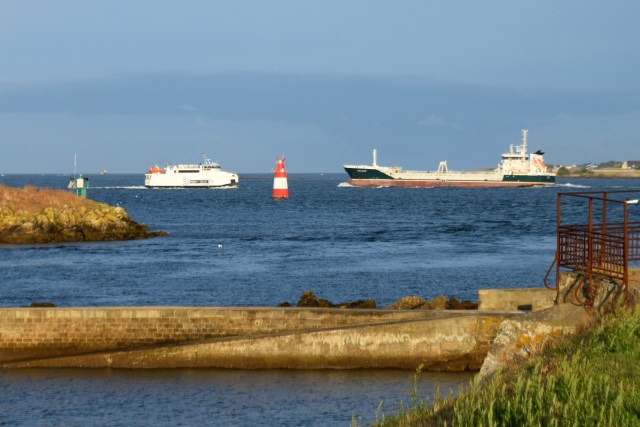
and ships plying the channel between the Port at L’Orient and the open sea.
17th. I spent the rest of the morning at the Citadel and could have spent even longer had Cassidy not been waiting for me in the van. The Euro 8 entrance fee was well worth every sou.Included in the price was an excellent audio guide available in English and voiced in a gentle Irish brouge. Once past the impressive entrance…..


The first item of interest is the sole remaining German bunker from WW2. They were all round the perimeter at the time but all except this one have since been removed.


There are two permanent museums on the site, The museum of Treasures of the Sea is all about goods and armaments (mostly canon) recovered from sunken ships. It is well presented and includes a video of a small submersible at work on a wreck. The second is the East India Company museum which has wonder 3D models of ships that were used to ply their trade between France (out of the local Port of L’Orient where most of them were built) to India, China and the Spice Islands. Below the ship building yard and port as it was in the C17 at L’Orient and the waterfront at Canton.


Scale models of ships gave an impression of life aboard


and sumptuous displays showcased the sort after items that were imported.


On the way out I detoured via the main beach lowering under what I am realising is a typical Brittany sky!
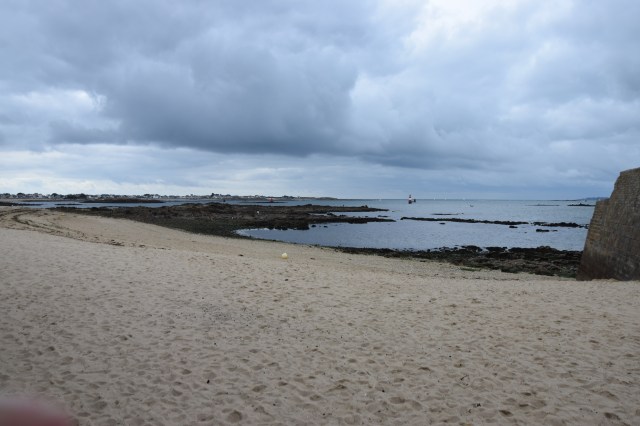
Behind the Aire is another big bunker which is a museum dedicated to the Martyrs of the Citadel and a reconstruction of the era. The striking thing about the Martyrs is how young most of them were.


18th. Moved on to Rohan today. Situated on the Canal Nates à Brest. I deviated, unintentionally, from my planed route and as so often happens it turned out to be a good idea as it took me through the pretty village of Noyal-Pontivy with its beautiful stone built Town Hall and Church.


Arriving at Rohan My view from the van of the small marina was a delight.
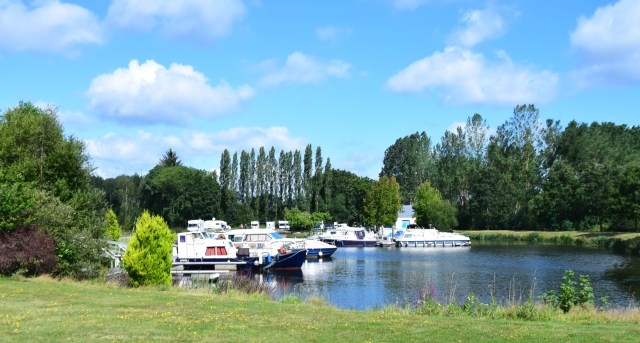
The canal was caused to be built in 1806 by Napolian the 1st to ensure free movement of goods within the region by avoiding the coast which was being blockaded by the British. There are two bridges across the canal in the town.


an old photograph shows how the older of the two used to look.


The Town Lock and weir are very attractive.
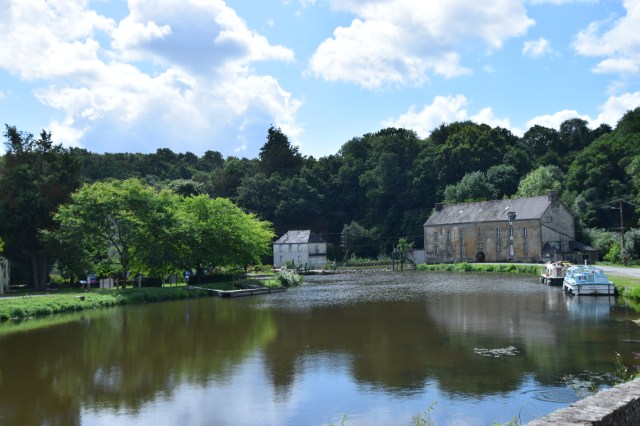


I took a cycle ride along the tow path and discovered many beautifully presented locks. In this direction the canal is moving up-hill and at one point the locks began to really step up with flights of seven or eight locks following one upon the other. The canal was too meandering to get a shot of the flights though.
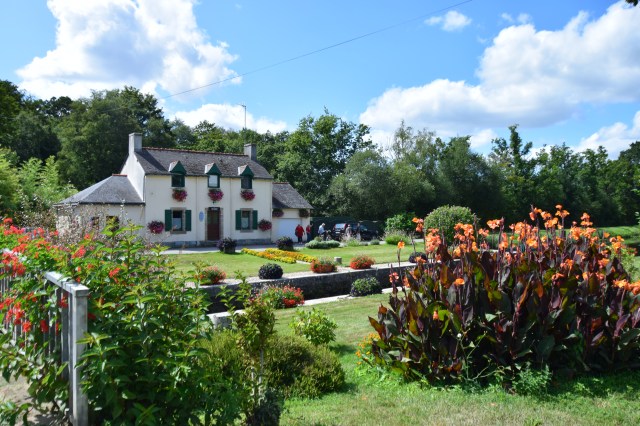


Back in the town there was an attractive market and a tourist map of the local area. The map shows the river Blavet, also navigable, to the west and this reminded me that while I was at the East India Company museum I read that Port-Louis started off being called “Blavet” and was a trading post set up be combined Dutch, Spanish and British efforts in the C13.


19th. Cycled in the other direction down the tow path. Much flatter with many fewer locks.
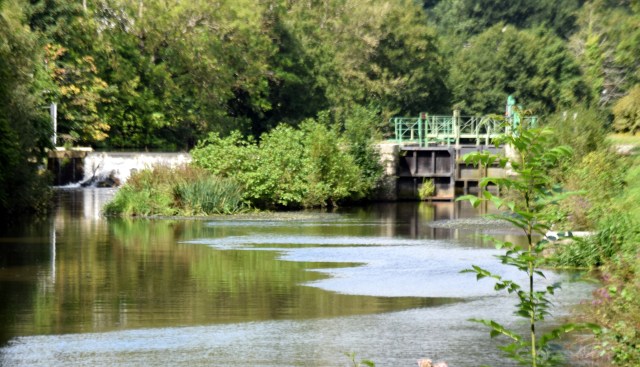
As I was beginning to think that navigating single handed would be impossible, due to the lack of mooring opportunities either side of the locks and the lack of ladders to allow climbing in and out of them, I met a solo boater being locked through by eclusieurs. It seems that it works much like the Canal de Bourgoyne, with a change of eclusieurs every three or four locks. It amused me that his boat was called “Carpe Diem”, the same as my narrow boat.


20th. Moved on to La Chéze this morning mainly because it has unmetered electricity points and I want to charge everything up before going to Joselin. The Aire is in a lovely spot between a river and a large fishing lake.


The village is pretty with hanging baskets and an attractive square.


There is the ruin of a Mott and Bailly castle but it is basically inaccessible.


21st I was going to stay at La Chéze for two days but the cycling is limited so I decided to move on to Josselin. The Aire was more of less in the centre of town which was very convenient but it was basically just a car park.
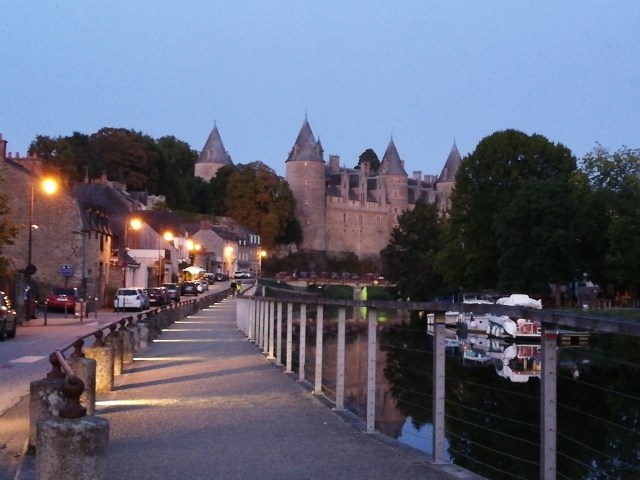
The town is very attractive with a large castle on the canal banks.


While this view was pretty amazing in the sunshine it was possitively stunning after dark and really up-lifted Cassidy and my evening walk.
The town centre is full of pavement cafes, restaurants and tourist shops. it is mostly pedestrianised, the streets are cobbled, there are a lot of timbered buildings and the shop signs are interesting.


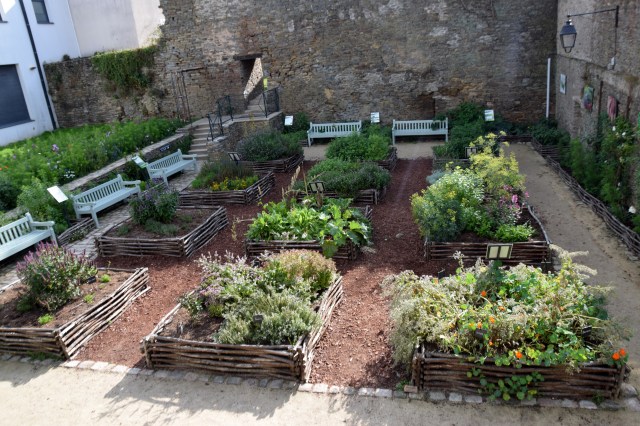
Tucked in a quiet corner is a recreation of a Medieval Garden full of enticing aromas.
The church itself is not that special but I really took to the flying pig!


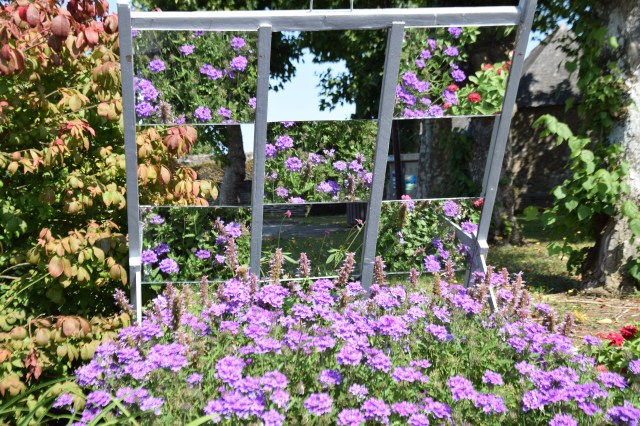
Back at the “car park” my eye was caught by a rather clever flower bed arrangement that I dubbed “Smoke & Mirrors”
I then moved onto the second, new and as yet unpublisised Aire right on the canal bank and took some rides in both directions.


22nd. OK.OK. I know. I lost a day somewhere, so I am catching up now. The events and photos are all in there somewhere just not under the right date which I do not really think is serious enough to loose sleep over. Today I moved on to Redon, in fact the Aire was in the suburb of St Nicholas-de-Redon, on the banks of the huge marina which is (I think) a branch off the canal that feeds without a lock into the river. Rather like the junction between Canal de Bourgoyne and the Saone. So there are essentially three waterways and multiple bridges between them which made navigating on terre firme to the Aire a bit of a challenge.


Bigger City, bigger marina, bigger boats. From my perspective this was all I had to say about Redon, which is not really fair and more a reflection on the fact that I am not really a Big City Girl!
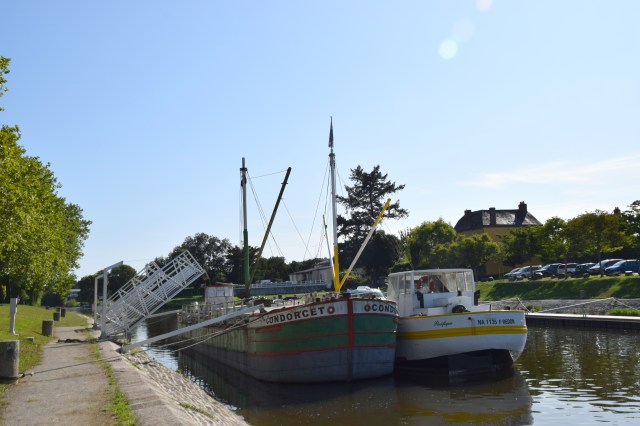
23rd. So this morning I moved on to Nozy where the Aire is adjacent to a water park with tele ski and a miniature wood criss crossed with MTB single track.


Just by the gate to the Aire is a Charcoal burning oven. Theses are quite common in wooded areas and there is one signed near St Savinien but this is the first one I have seen.


The town is not a tourist destination and doesn’t have any obvious charm but what it does have is a vibrant high street with some surprisingly up market shops from Kitchen equipment to home decor to classy lingerie. A new shop about to open is going to do a farm to table offering of local produce where the buyers will be able to identify the source of what they buy.


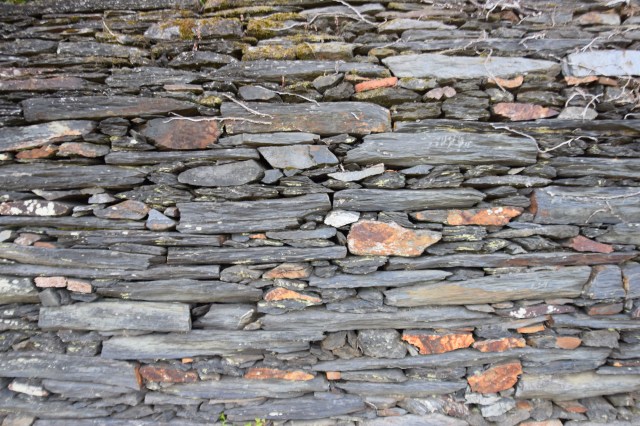
Shale has replaced granite as the building stone. While it is not unattractive it is even more sombre than the granite.
Today and tomorrow will be work, hand laundry, hair wash and cook up a BIG bowl of blackberries and apple. The only minor catastrophe was Cassidy knocking the table over with the bowl on and emptying the lot on the floor. As they say “there is plenty more where that lot came from ” so I will just have to do re-run tomorrow. There was a delicate pink sundown.


24th. Worked all day what with portfolios and blackberries.
25th. Moved on to the clifftop village of Champtoceaux over looking the Loire valley. I had heard from other campers that the Loire was dry and while here some locals told me that all the sand should be covered in normal times.


For centuries there has been a fort on top of the promontory but it was apparently ordered raised to the ground by Jean V.
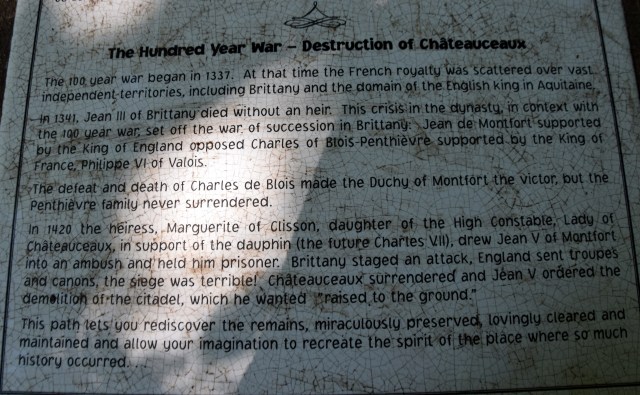
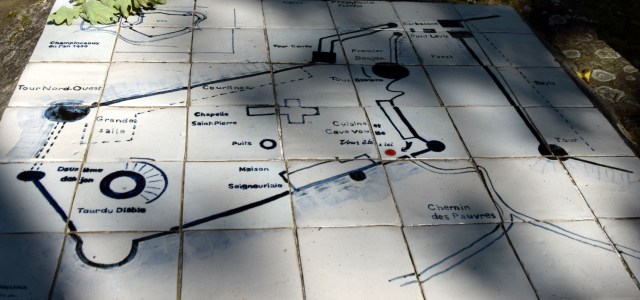
He did a pretty good job because all that remains today is traces of the Well, the living quarters, the church and the DonJon and if the plan didn’t tell you what was what most of it would just be so much rubble.




The section of damaged wall above shows that it was at least 2mt thick. It mudst have taken something to pull it all down especially given that this was 1420.
The story boards are great and for a change there is an adequate English translation. Usually what has taken a good paragraph to explain in French is reduced to a couple of sentences in the English version. HOWEVER! Here is the Moulin Pendu (hanging mill) and the story board.


This explains that a dam was built forcing ships to pass through the arches where they were taxed. Meanwhile back at the museum There are drawings of the paddle wheels at river level and the mill engines on the first floor which version the curator assured me was the correct one! Taxes were indeed levied but that took place further up stream!
An C18th impression of the town and some handsome C218th towers.


In the afternoon we walked down the hill via a tunnel under the road to the next village of La Patache.


One of the most delightful features of the day being the lovely wooded walks.
26th. The intention was to spend the night at St-Philbert-de-Grand-Lieu whose Aire was highly praised in the Aire directory. It did overlook a large lake but it was also behind a large commercial precinct and after a good walk around the area I decided that it looked and felt decidedly dodgy. We moved on to Machecoul where the Aire was on the edge of a lovely and well maintained park but also right next to a busy road. Come evening as no other vans had pulled in it also began to feel a bit exposed so I moved into the suburb on the other side of the park and found a quiet spot. The Church and ruined castle at Machecoul.


27th. Today I called in at Idylcar in Dompierre-sun-Yon to look at at Citroen camper conversion. At 1.96m high it will certainly fit into the garage but there is a decided lack of storage and although it would be a great everyday car I think it will be a bit cramped for long stays on the road. Probably a second visit it justified though. For this evenings stop I am going to St Amand-sur-Sevre where the Aire is a bit out of the village, by the river and an old Mill. It is really delightful so I have booked in for two nights and will have a bit of a rest. On Cassidy and my evening walk I caught site of an otter crossing the river. Second sighting this trip. What a joy.


28th. Stayed put and did not much. It is so quiet and peaceful. Noticed that the plastic wheel housing that is supposed to be fixed above the wheel has come loose and it practically scraping the ground. I will have to find a garage to detach it tomorrow before I loose it.
29th. Moved south to the Marais Poitevin in Deux Sévre. This is an area that I have been wanting to visit since I arrived in this part of France and is almost on my doorstep. Stopped at the Renault Garage in Cerizay. They attended to it straight away and must have taken about half an hour on the job but charged me nothing. The Aire in Coulon has been up-graded and now has electricity, nice parking with plenty of shade and a good toilet block. The Town is pretty with a nice church square and an interesting pump.


There are some pretty streets and alleyways…..


But of course the main attraction is the Sévre itself and the adjoining waterways. It is not for nothing that it is known as Le Venice Vert (the green Venice) with its Venetian style bridge and it gondoliers.


The town Houses along the quai are handsome,
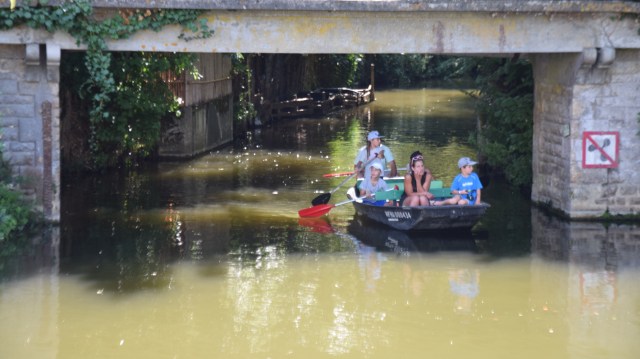
and secret waterways beckon. I will get a good chance to explore these at 9am tomorrow when I have booked a one and a half hour guided boat ride.
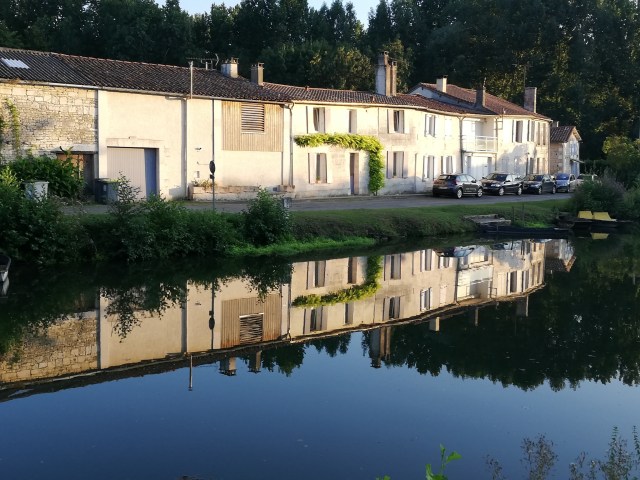
In the evening we were treated to some lovely reflections as we walked along the main canal.


30th. At 9am we set off to explore the secret waterways….


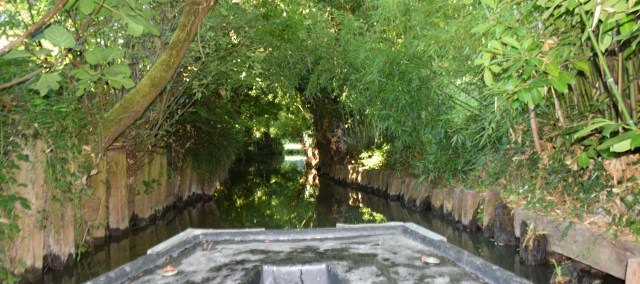
There are directional signs at all the main intersections, much like road signs, without which navigating this maze of waterways would be impossible for the self guided tourist.


The canals are of course man made and apparently the Dutch were called in to assist at some point due to their experience with building dykes. A variety of Willow is planted along the edges because its roots help to bind the banks together. The Willow wood was also used for a number of purposes including the making of clogs.


Another tree, a fast growing soft wood, is also planted and harvested for many uses including making matches and pellets for the increasingly popular pellet burning stoves. Beef cattle are bought out to the paddocks in April, by boat, and left to graze till October, needing no attention. For this purpose and for transporting timber exceptions are made to the exclusion of motor boats.


Previously the Marais would have been a network of small farms mostly devoted to the growing of vegetables. Wild hops, angelica (a local specialty) and Valorium, the herb from which Valium is extracted are much in evidence. Casidy was curious, interested and exceptionally well behaved…….


even when we passed Coypu on the bank, although he would dearly have loved to chase them. They were first introduced from South America in the 1880’s for use in Fur Coats and for their meat.


The hour and a half passed all too quickly. I am pleased that I chose to go on the first available time in the morning because it was not until we were on the home stretch that we encountered two other boats just starting out. A magical and tranquil experience well worth forking out to have it all to myself. My guide was informative especially once he realised that I was interested in what he had to say.


31st. I had a good morning ride. Managed 16k, my longest since I started cycling again after the wrists! I started off on the cycle track but finished the ride on the road as the track was uncomfortable without MTB tyres and shocks. A large functioning lock and lift bridge demonstrates the fact that the waterways do still have some commercial use as stated by my guide of yesterday, cattle in and out and timber out. So the story board is not quite right in its assertion that they now only carry tourist and leisure traffic.


Then we set off on the short drive to Mauze-sur-le-Mignon which was described in the Aire book as having a handsome C19 Port. Unfortunately they were tardy in undertaking the work to enlarge and deepen the port and build the infrastructure and by the time it was finished the railways had been established and the port was left to the ducks.


 capetocarpe